Internal Shutters for Sash and Case Windows: 2026 Guide
Table of Contents
Why Sash and Case Windows Suit Internal Shutters
Privacy and Light Control for Street-Facing Rooms
Insulation and Energy Efficiency in Period Properties
Full Height vs Tier-on-Tier Shutters
Material Options: Hardwood, MDF and PVC
Hardwood Shutters for Architectural Integrity
MDF and PVC: Budget-Friendly Alternatives
Mounting Options and Hardware Compatibility
Recess Fit vs Face Fit for Deep Recesses
Hardware Clearance and Sash Operation
Made-to-Measure Shutter Lead Times
The Cost of Internal Window Shutters
Maintenance, Restoration and Conservation Areas
Routine Care Without Damaging the Window
Restoring Original Shutters
Do Internal Shutters Need Consent?
How to Check Before You Commit
Frequently Asked Questions
Last Updated: September 26, 2026
Why Sash and Case Windows Suit Internal Shutters
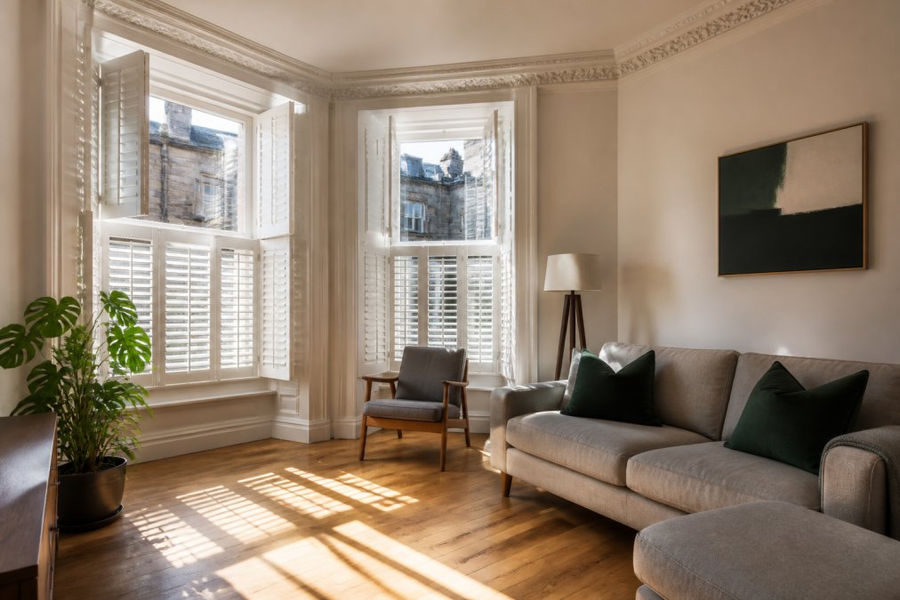
Internal shutters for sash and case windows are a natural match because the deep recesses these windows sit in were originally designed to house solid timber shutters. That recess, often 15cm to 25cm deep in Victorian and Georgian properties, gives you space to mount shutter panels without eating into the room. This guide covers what actually matters: fit, materials, hardware clearance, and what it costs.
The traditional pairing isn't nostalgia. Sash and case windows slide vertically on cords and weights, and their frames are rarely square after a century of settlement. Off-the-shelf blinds fight that geometry. Made-to-measure shutters are built to it.
Privacy and Light Control for Street-Facing Rooms
Tenement flats and townhouses sit close to the pavement. Ground-floor and first-floor rooms are overlooked constantly.
Shutters solve this better than curtains because you control the top and bottom independently. Open the top louvres for daylight, keep the bottom section closed against the street. That single feature is why street-facing rooms in period homes are the most common shutter installation.
Insulation and Energy Efficiency in Period Properties
Single-glazed sash windows lose heat. That's not a sales pitch, it's physics, and it's why so many period properties feel cold even with the heating running.
Shutters add a layer of still air between the glass and the room, which reduces heat loss and cuts draughts around the sash cords. They won't match double glazing on their own, but for a listed or conservation-area property where you can't replace the windows, they're one of the few improvements you can actually make.
Key Takeaway Shutters work best as part of a wider draught-proofing effort: brush seals on the sashes, plus shutters, will do more than shutters alone.
Full Height vs Tier-on-Tier Shutters
The two configurations suit different rooms, and picking wrong is the most common expensive mistake.
Full height shutters run as one continuous panel from top to bottom.
Configuration | Best For | Trade-off |
Full height | Uniform look, bedrooms, less-used rooms | Can't split light control top from bottom |
Tier-on-tier | Street-facing rooms, living rooms, home offices | More panels, more hinges to align |
Café style | Half-window coverage, street privacy | Leaves upper window bare |
Material Options: Hardwood, MDF and PVC
Material choice drives both cost and how the shutters age. There are three realistic options, and each has a clear best use.
Hardwood Shutters for Architectural Integrity
Hardwood is the right call for period homes where the shutters need to look original. It takes paint and stain properly, holds fine detail on the louvres, and can be repaired and repainted rather than replaced. In a Georgian or Victorian property, hardwood shutters read as part of the architecture rather than an addition.
MDF and PVC: Budget-Friendly Alternatives
MDF is stable, smooth, and takes paint well. It won't warp in the way cheap softwood can, and it costs meaningfully less than hardwood. For busy family homes where durability matters more than period authenticity, it's a sensible pick.
Watch Out PVC shutters in a south-facing bay window can discolour and become brittle over time. If the room gets direct sun for hours a day, hardwood or MDF will outlast them.
Mounting Options and Hardware Compatibility
This is where most generic guides stop, and where sash window installations actually get difficult.
Recess Fit vs Face Fit for Deep Recesses
Recess fit mounts the shutters inside the window opening, flush with the reveal. It looks cleanest and preserves the depth of the recess. It only works if the recess is deep enough to clear the sash handles and the window furniture.
Hardware Clearance and Sash Operation
Sash windows have a sash lift, a lock, and often a sash fastener in the middle of the meeting rail. Shutters must clear all of it.
Measure sash lift projection
Measure the lock or fastener depth
Check the meeting rail position
Confirm the sash cords and pulleys aren't obstructed
Made-to-Measure Shutter Lead Times
Made-to-measure shutter lead times vary widely by supplier and material, and this is the single biggest frustration buyers report.
The Cost of Internal Window Shutters
The cost of internal window shutters depends on window size, material, configuration, and how many windows you're covering. There's no single figure, and any supplier quoting one without seeing your windows is guessing.
What drives the price up:
Hardwood over MDF
Tier-on-tier over full height
Bay or shaped windows
Deep recesses needing custom frames
What keeps it down:
Standard rectangular windows
MDF in a painted finish
Multiple windows ordered together
Maintenance, Restoration and Conservation Areas
Shutters need very little upkeep, but the maintenance that matters is the maintenance that protects the window behind them.
Routine Care Without Damaging the Window
Dust the louvres with a soft brush or a vacuum on low suction. Avoid wet cloths on painted louvres, which can soften the paint edge and leave streaks.
Clean painted panels with a barely damp cloth and a mild soap, then dry immediately. Solvent cleaners can lift the paint film on older hardwood shutters.
Check the hinges annually. A drop of light machine oil on the knuckle keeps panels swinging true and stops the screws working loose in the frame.
Watch the paint line where the shutter frame meets the reveal. This is the joint most likely to crack as the timber moves seasonally, and it's the first place water ingress shows if a window above leaks.
Never sand or scrape back to bare timber around the sash cords, pulleys or the original window frame. The paint on an old sash window is often lead-based, and disturbing it is both a health issue and, in a listed building, a consent issue.
Restoring Original Shutters
Many period properties still have the original shutter panels, either in place or stored in a cupboard or loft. These are almost always worth restoring rather than replacing. A joiner can re-hang panels on repaired or matched hinges, replace a split stile, and match the original moulding profile so the repair is invisible once painted. Original shutters also carry the correct proportions for the window, which modern replacements rarely match exactly.
Do Internal Shutters Need Consent?
This is the question most guides skip, and it's the one that can cost you money if you get it wrong.
Watch Out Do not assume that because shutters are internal and reversible, listed building consent is not needed. Unauthorised works to a listed building are a criminal offence, and the fact that a fitting is 'temporary' or 'easily removed' is not a defence. Check with your local planning authority's conservation officer before you order.
How to Check Before You Commit
Confirm whether the property is listed, and at what category, and whether it sits in a conservation area. Your local planning authority holds this.
Ask the conservation officer directly whether internal shutters to the existing windows would need consent, and describe the design, material and fixing method.
If consent is needed, submit it before ordering. Made-to-measure shutters are non-returnable, and a refused application after manufacture is an expensive outcome.
Keep the fixing reversible. Shutters that screw into the reveal rather than into the original window frame are easier to remove and less likely to be objected to.
For listed buildings, look at the statutory guidance on listed building consent and the principles of minimal intervention before you design the scheme. Historic Environment Scotland's guidance on listed buildings and consent
The general principle that runs through all of this is the same one that applies to any work on an old building: keep it reversible, keep it in keeping, and ask before you alter rather than after.
Frequently Asked Questions
Can you install internal shutters on traditional sash and case windows?
Yes, internal shutters are a practical addition to sash and case windows. The key is choosing a mounting method that does not interfere with the sash cords or the window's sliding operation. Recess fit works well in the deep reveals typical of Victorian and Georgian properties, while face fit suits shallower frames. A professional survey confirms clearance for the sash to move freely before installation.
Are full-height or tier-on-tier shutters better for sash windows?
It depends on how you use the room. Full-height shutters cover the entire window with one continuous panel, giving a clean, modern look and maximum privacy. Tier-on-tier shutters split the window into independent top and bottom sections, so you can open the lower louvres for light while keeping the upper section closed. For street-facing rooms in period homes, tier-on-tier offers more flexible light control.
Do internal shutters provide better insulation for older windows?
Internal shutters add a layer of draft exclusion that reduces heat loss through single-glazed sash windows. The improvement depends on the fit, the material and whether the shutters are closed. Hardwood shutters with tight tolerances perform better than loose-fitting alternatives. For the best thermal efficiency, combine shutters with draught-proofing strips on the sash itself. A U-value assessment can quantify the benefit.
How much do indoor shutters cost per window?
The cost of internal window shutters varies with window size, material choice and mounting complexity. Hardwood and bespoke joinery options cost more than MDF or PVC. Tier-on-tier configurations typically cost more than full-height panels because of the additional frame and hardware. For a made-to-measure quote tailored to your sash and case windows, check the Caledonia Shutters pricing page or request a survey.
Do I need planning permission for shutters in a conservation area or listed building?
Internal shutters normally do not require planning permission because they are not a permanent external alteration. However, in a conservation area or listed building, any change that affects the character of the property may need consent. If your shutters are visible from outside or involve altering the window frame, check with your local planning authority before ordering. Made-to-measure shutters that sit within the existing recess are usually acceptable.
Book Now!


Comments