

How to Tell If Shutter Material Is High Quality
Last Updated: November 15, 2026
Quick Summary
High-quality shutter material is dense, consistently finished and honestly labelled, so judge it by weight, joint construction, finish and edge sealing rather than colour or price. Ask for a physical sample and a written specification naming the specific material, core construction and panel thickness.
Lift the panel by its stile: a dull thud means solid material, a hollow echo means a thin skin over a void.
Quality shutters use glued and pinned mortise-and-tenon joints with tight seams and no visible gaps.
On MDF or composite shutters, every cut edge must be sealed to prevent moisture ingress.
For bathrooms, choose PVC, vinyl or a sealed composite, since solid timber and standard MDF struggle with constant steam.
Ask for the specific material name, core construction and panel thickness in writing rather than vague terms like premium wood.
Not sure which shutter material suits your room?
We fit made-to-measure shutters across Glasgow and the wider region, with clear pricing and in-house fitting.
Table of Contents
How to Choose Shutter Material Without Getting Caught Out
Most shutter buyers judge quality by colour and price. The material underneath is what decides whether the shutters still look right in ten years, and it is the part brochures rarely explain properly.
Below, we show you exactly how to inspect a sample, read a label, and match material to room, so you can tell quality before you commit. First, though, here is what most guides get wrong: they rank materials by prestige rather than by where the shutters will actually hang.
Match the Material to the Room, Not the Brochure
A kitchen shutter and a bedroom shutter face very different conditions. Steam, condensation and direct sun exposure all stress timber differently, so the right material for one room can be the wrong choice for another. Start with the room, then choose the material.
Ask three questions before you look at any sample:
Will this window see steam or splashes regularly?
Does it face strong afternoon sun?
Is the window large enough that panel weight matters?
British Standards Institution guidance on building products is a useful starting point for understanding how construction products are specified and tested.
Ask for a Sample Before You Commit
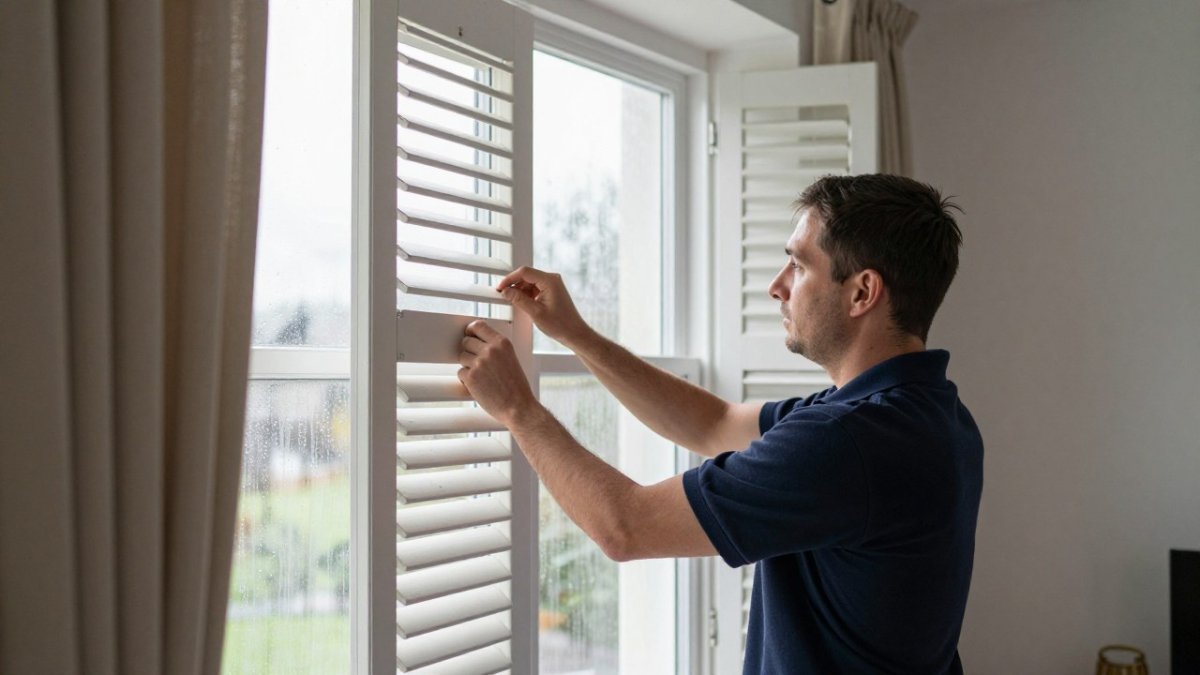
Never buy made-to-measure shutters from a photograph alone. A physical sample lets you judge weight, finish and joint construction in your own hand, under your own light.
When the sample arrives, hold it up to the window it is destined for. Check how the colour reads in daylight, run your fingers along the louvre edges, and flex the panel gently.
Timber Shutters vs MDF Shutters: What the Difference Means in Practice
Timber shutters are made from solid wood, while MDF shutters are built from compressed wood fibres. That difference shows up in weight, moisture behaviour and how each material ages. Timber feels denser and can be sanded and refinished; MDF is uniform and stable but swells if water reaches an exposed edge.
In practice, timber suits larger windows where strength matters and rooms where you want a natural grain under stain. MDF suits bedrooms and living rooms on a tighter budget, provided the edges are properly sealed. Here is how the main options compare:
Material | Best For | Watch Out For |
Hardwood timber | Large windows, stained finishes | Higher cost, needs stable humidity |
Engineered wood | Wide panels, consistent finish | Check core density, not just the face |
MDF | Bedrooms, budget projects | Swelling at unsealed edges |
PVC or vinyl | Bathrooms, wet rooms | Can look flat beside timber |
Where Composite and Engineered Wood Fit In
Composite and engineered wood sit between the two extremes. Engineered wood layers a real wood face over a stable core, which reduces warping on wide panels. Composite blends wood fibre with resin for better moisture resistance than plain MDF.
If you are weighing up whether the upgrade is worth it at all, our guide on how to decide if shutters are worth the investment sets out the long-term case before you spend more on premium material.
Waterproof Shutters for Bathrooms: What Actually Survives Steam
For bathrooms, the practical answer is PVC, vinyl or a sealed composite, because solid timber and standard MDF both struggle with constant steam.

Watch out: a "water-resistant" MDF panel with an unsealed bottom edge will swell within a couple of damp winters.
For a deeper comparison of materials built for steamy rooms, read our guide to the best shutter materials for humid bathrooms.
The Plantation Shutter Quality Checklist for Showroom and Online Buying
Use this checklist whether you are visiting a showroom or ordering online. Each item is something you can verify yourself, and no single failure rules a product out, but several together should make you pause.
Weight and density: Lift the panel by its stile. A quality hardwood or dense composite panel will feel heavier than its size suggests. Tap the stile with your knuckle: a dull thud indicates solid material, while a hollow echo suggests a thin skin over a void or a low-density core. If the panel rattles when shaken, the joints are loose.
Joint construction: Examine the corners where stiles meet rails. High-quality shutters use glued and pinned mortise-and-tenon joints, often with dowels or biscuits for added strength. Look for tight seams with no visible gaps or movement. Run your fingernail along the joint; if it catches, the fit is poor. On painted shutters, check that paint has not bridged a gap, which can hide a loose joint.
Finish quality: Paint or stain should be even, with no drips, runs, or thin patches. On painted surfaces, look for a smooth, consistent sheen and check edges and louvre ends for coverage. On stained timber, the grain should be visible and consistent, with no blotchiness. Run your hand over the surface; it should feel smooth, not rough or gritty. A quality finish will also be applied to all faces, including the top and bottom edges of the panel.
Louvre tension and operation: Tilt the louvres using the tilt rod. They should move smoothly and hold their position firmly without sagging. Check that all louvres in a panel are aligned and that the tension is consistent across the panel. If louvres droop or feel loose, the tension pins or mechanism may be of low quality. For larger panels, ensure the tilt rod is sturdy and securely attached.
Hinges and frame components: Hinges should be metal (stainless steel or brass) and feel substantial. Open and close the panel; it should move smoothly without binding or squeaking. Check that hinges are properly mortised into the frame and panel, not surface-mounted. The frame itself should be solid, with no knots or weak points, and fixings should be appropriate for the wall type.
Labelling and specification: The material should be named specifically (e.g., ‘solid basswood’, ‘MDF with sealed edges’) rather than vague terms like ‘premium wood’. Ask for the panel thickness and core material in writing. Reputable suppliers will provide a specification sheet detailing composition, coating, and warranty terms.
If you are buying online and want to weigh material quality against cost, our transparent internal shutter price guide for Scottish homes lets you enter your sizes and see prices before you decide.
How to Spot Misleading Material Labels
Vague labels are the most common way buyers get caught out. ‘Premium wood’ and ‘solid wood effect’ can describe a thin veneer over a soft core, and ‘waterproof’ often means splash-resistant at best.
Here is how to decode common labels:
Solid hardwood: Should mean solid wood throughout, not a veneered face. Ask which species (e.g., basswood, oak, meranti) and whether it is kiln-dried. Solid hardwood can be sanded and refinished, but may warp if humidity fluctuates.
Engineered wood: A real wood face (veneer) over a core of plywood or high-density fibreboard. The quality depends on the core density and the thickness of the veneer. Ask for the core material and density; a dense core resists warping better. Engineered wood is more stable than solid wood but cannot be sanded as aggressively.
MDF (medium-density fibreboard): Compressed wood fibres with resin. It is uniform and stable but swells if water reaches an exposed edge. Quality MDF shutters will have sealed edges and a moisture-resistant coating. Ask for the density (higher density is better) and whether the MDF is moisture-resistant (often coloured green or blue).
Wood composite: A broad term that can mean anything from dense fibreboard to a mixture of sawdust and resin. It is not a guarantee of quality. Ask for the specific composition and density.
PVC or vinyl: Synthetic plastic, inherently waterproof. Quality PVC shutters use rigid, UV-stabilised PVC that resists yellowing. They can look flat compared to timber, but are suitable for bathrooms. Ask about UV resistance and warranty against yellowing.
Waterproof: No shutter is fully immersible. ‘Waterproof’ should be replaced by a clear statement of what the finish resists, such as ‘suitable for bathroom environments’ or ‘moisture-resistant MDF with sealed edges’.
A few phrases deserve a direct question:
‘Wood composite’ may mean anything from dense fibreboard to sawdust and resin. Ask for the percentage of wood content and the binder used.
‘Solid wood’ should mean solid throughout, not a veneered face. Ask if the core is the same species as the face.
‘Waterproof’ should be replaced by a clear statement of what the finish resists. Ask for test data or warranty terms that specify moisture exposure.
If a seller cannot answer these questions plainly, treat that as your answer. Reputable suppliers will provide a specification sheet and be happy to explain the differences.
Components and Fitting Quality Matter as Much as the Material
A perfect panel on poor hinges still fails. Hinges, frames, louvre tension pins and the fitting itself decide how the shutters feel day to day and how long they last. Ask what the hinges are made of, how the frame is fixed to the wall, and who carries out the installation.
At Caledonia Shutters, our in-house fitting teams handle both design and installation, so the people who measure your windows are the same people who fit the shutters.
Book a Home Survey and Check the Material in Person
The most reliable way to judge shutter material is to see and handle it in your own home, on your own windows.
UK government guidance on commissioning home improvement work is worth reading before you sign anything, particularly on written quotes and cancellation rights.
Caledonia Shutters covers Glasgow and the wider region, including remote areas, with made-to-measure shutters and transparent pricing. You can explore our plantation shutters range for Scottish homes and see the materials in person before you commit. If you are still deciding whether bespoke shutters suit your property, our article on whether made-to-measure shutters in Scotland are worth it walks through the trade-offs.
Judging shutter material comes down to a few honest checks: weight, density, joint construction, finish and a label that names exactly what you are buying.
Frequently Asked Questions
How can you tell if plantation shutters are good quality?
Check the joints first: well-made panels have tight, even mitres with no visible gaps or filler. Look at the louvre edges for a smooth, hand-sanded finish rather than a rough or drippy coating. Weigh the panel; a dense, solid feel usually signals better material than a hollow, light one. Finally, ask what the frame and hinges are made from, because flimsy components fail long before the shutter material does.
Are MDF shutters as durable as timber shutters?
For most internal windows, a good-quality MDF shutter holds up well and keeps its shape in dry rooms. Timber is stronger at the joints and can be sanded and re-finished if it gets marked, which matters in older properties with uneven walls. In bathrooms and wet rooms, neither plain MDF nor untreated timber is the right choice; look for a waterproof material with a sealed coating instead.
Are waterproof shutters suitable for bathrooms?
Yes, provided the material is genuinely sealed throughout, not just painted on the surface. PVC, vinyl and coated composite panels resist steam and humidity without swelling or warping. Check that the frame, hinges and fixings are also moisture-resistant, since these are often the first parts to fail. A hardwearing paint or polypropylene coating on every edge is the detail that separates a bathroom-safe shutter from one that blisters within a year.
How thick should shutter louvres be?
Thicker louvres resist warping and feel more solid, which is a useful quality signal when you handle a sample. Very thin louvres can flex and rattle, and they show dents more easily on large windows. Ask the supplier for the louvre thickness in millimetres and compare it across the materials you are considering. If a company cannot tell you the specification, that is a warning sign in itself.


Comments